“I should have my full measure of misery on the sea before I reached my native lands”
Odysseus, The Odyssey.
This blog gets its name from the epic poem The Odyssey, which is accredited to Homer and was most likely created in the 8th century BCE. The story follows Odysseus and the various trials and tribulations he faced, in his 10-year journey home after the Trojan War, a full rundown of which can be found here. The Odyssey is most famously associated with mythological creatures: such as Circe, Scylla and Polyphemus that Odysseus must conquer to return to Ithaca. However, the main protagonist throughout can be interpreted as the sea, which is represented by the character of Poseidon, who is the god of this domain. Odysseus is the target of the wrath of Poseidon, because he blinded his son, the cyclopes Polyphemus. He attempts to delay Odysseus’ return home, by making the sea unnavigable and assuring that he is directed towards various evils that may cause harm or lead to difficult choices.
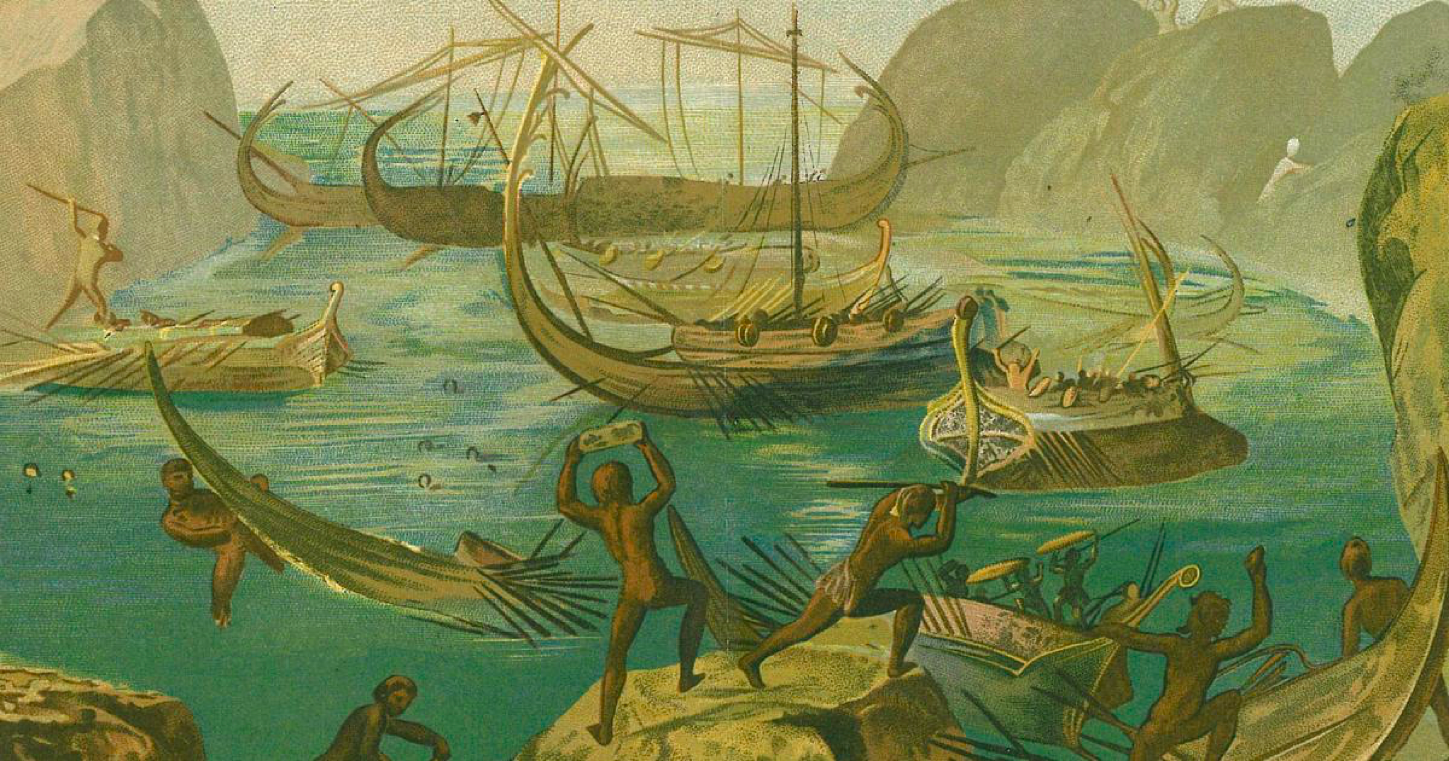
Within The Odyssey, the sea can be understood as a metaphor for separation. Not only does the sea prevent Odysseus’ return to Ithaca but it provides a way of dividing humans and the gods. This presents the sea, as a space in which humans are at the mercy of the gods, with the fear associated with angering them strengthened throughout the story. The basic premise of an epic is to give form to a moral world by which the audience should live their lives. Therefore, the Odyssey can be read as a cautionary tale of the consequences of disrespecting the gods, with the sea being the physical manifestation of their disapproval. The quote at the beginning of this blog, is Odysseus cursing his luck when attempting to leave Calypso in Ogygia. This is the realisation that his suffering, at the hands of Poseidon, is far from over and that the sea will continue to immobilise and keep him away from Ithaca.
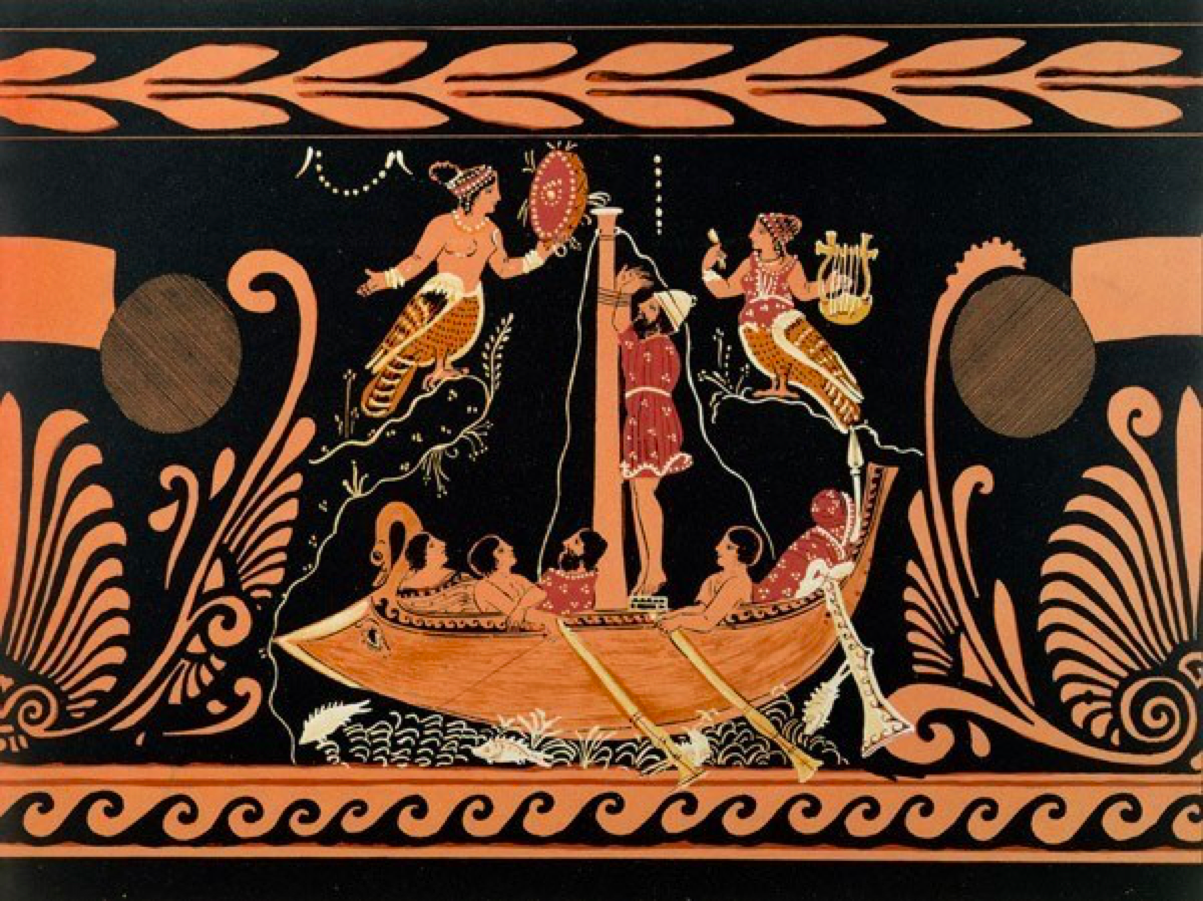
Odysseus trying to resist the allure of the sirens, can be found here.
Such examples help to reinforce the fear of the sea that is strongly associated with Ancient Greek civilisation. This is described by Lindenlauf as a “permanent disposal place”, whereby the sea is seen as an effective way for people and objects to be consumed and forgotten; which is what Odyssey is fearing at this point within the epic. This is exhibited in different ways, as various monsters and creatures within Greek mythology are sea-based. Worse still, examples such as the sirens and the lotus-eaters, would trap their victims at sea before killing them. Presenting a tangible way that people believed they could become forever lost at sea. As such The Odyssey presents the perception of the sea, as a domain that offers the possibility of mobility but it is strongly represented as a space that is controlled and regulated by the gods, which, if angered can cause a permanent disposal of people and ships.
WORD COUNT: 487
Bibliography
Brown, C.S. (1966) ‘Odysseus and Polyphemus: the name and the curse’, Comparative Literature, 18(3), pp. 193-202.
Encyclopedia Britannica. (no date) ‘Lotus-Eaters’, Encyclopedia Britannica [Online]. Available at: https://www.britannica.com/topic/Lotus-Eater (Accessed: 24th February 2019).
Friedrich, R. (1991) ‘The hybris of Odysseus’, The Journal of Hellenic Studies, 111, pp. 16-28.
GreekGods.org (no date) ‘Posideon’, GreekGods.org [Online]. Available at: https://www.-greek-gods.org/olympian-gods/poseidon.php (Accessed: 24th February 2019).
GreekMythology.com (no date) ‘Sirens’, GreekMythology.com [Online]. Available at: https://www.greekmythology.com/Myth-s/Creatures/Sirens/sirens.html (Accessed: 24th February 2019).
Greene, W.C. (1914) ‘The Sea in the Greek Poets’, The North American Review (1821-1940), 199(700), pp. 427-443.
Higgins, C. (2013) ‘The Odyssey: a soldier’s road home’, The Guardian, 30th November [Online]. Available at: https://www.theguardian.com/books/2013/nov/30/odyssey-soldier-afghanistan-military-homer (Accessed: 24th February 2019).
Lindenlauf, A. (2004) ‘The sea as a place of no return in ancient Greece’, World Archaeology, 35(3), pp. 416-433.
Louden, B. (2011) Homer’s Odyssey and the Near East. Cambridge: University Press.
Mackie, C. (2017) ‘Guide to the classics: Homer’s Odyssey’, The Conversation, 4th September [Online]. Available at: https://theconversation.com/guide-to-the-classics-homers-odyssey-82911 (Accessed: 24th February 2019).
Quartermain, C. (2016) ‘The goddess Calypso in Greek mythology’, Greek Legends and Myths, 23rd October [Online]. Available at: https://www.greeklegendsandmyths.com/cal-ypso.html (Accessed: 24th February 2019).
Worley, P. (2013) ‘How to use the enduring power of Greek myths in your classroom’, The Guardian, 28th February [Online]. Available at: https://www.theguardian.com/teacher-network/teacher-blog/2013/feb/28/teaching-greek-myths-odyssey-philosophy-lesson (Accessed: 24th February 2019).
Yoshida, A. (2019) ‘Epic: Literacy Genre’, Encyclopedia Britannica, 12th February [Online]. Available at: https://www.britannica.com/art/epic (Accessed: 24th February 2019).
 An Odyssey of the Sea 1913572