“When I look on the multitudes of Polypes inhabiting such a structure…I cannot help thinking of the heavenly City, the Jerusalem which is above”
Philip Henry Gosse, The Aquarium.
The idea of the modern home aquarium dates back to the 19th century, with various inventors attempting to perfect a way to house marine life in the home. Anne Thynne is credited as the creator of the first stable aquarium, sustaining stony corals and seaweed for almost three years. Home aquariums would become a fad that would spread across Victorian England, and were launched by Philip Henry Gosse in the early 1850s, when he created the first public aquarium at the London Zoo, as well as designing a manual entitled The Aquarium: An Unveiling of the Wonders of the Deep Sea. This informed regular people on how to sustain a home aquarium, bringing them with a closer proximity of the sea. The growing obsession with home aquariums, could be understood as one influence within the growing public imagination of the sea, alongside literacy works such as Twenty Thousand Leagues Under the Sea.
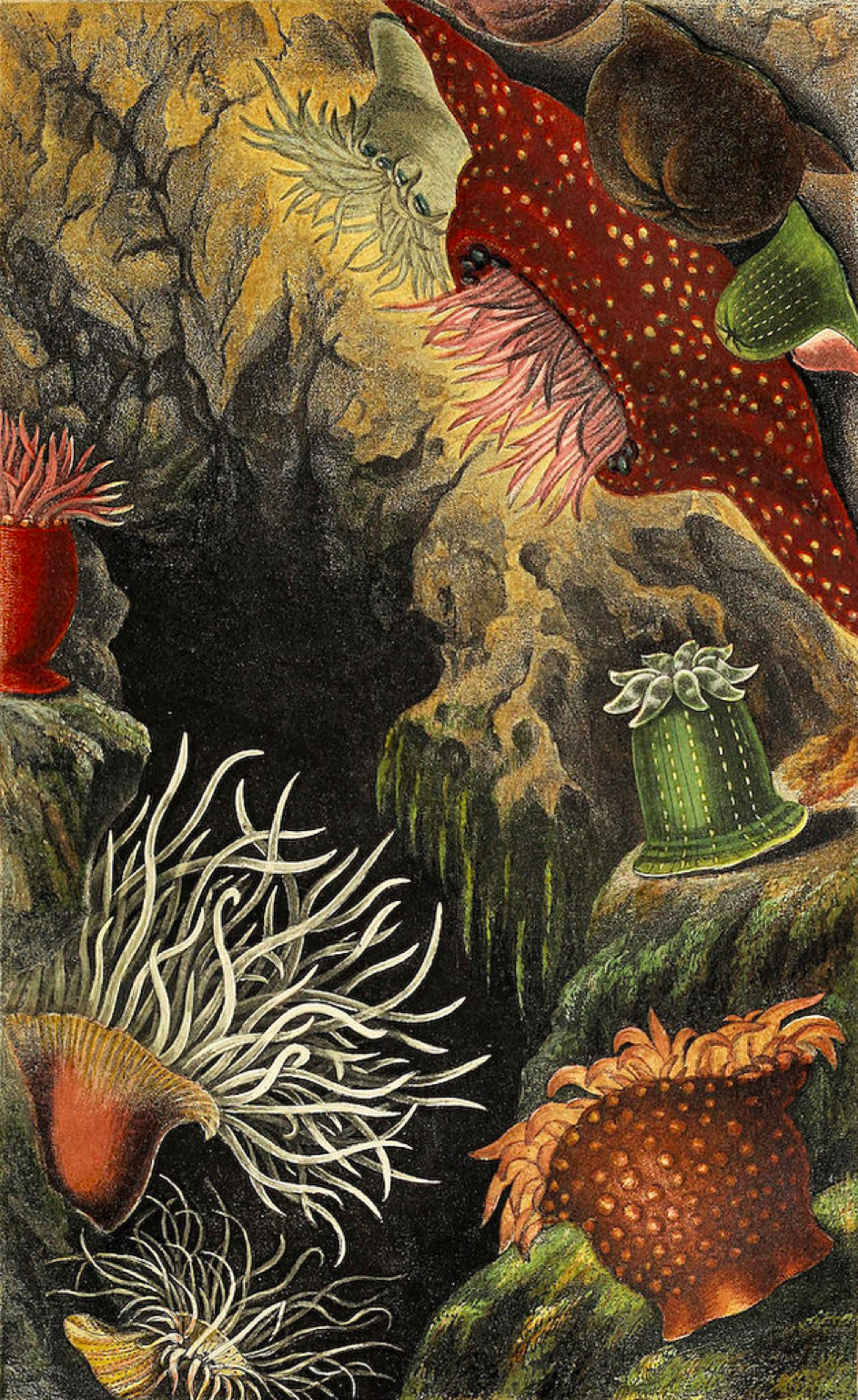
One of the illustrations of an aquarium by Philip Henry Gosse, can be found here.
The quote at the beginning of this blog, comes from Gosse’s manual and compares the aesthetic impact of an aquarium to that of heaven, suggesting that fascination is a key reason why people want to bring the sea into the home. During this time, knowledge surrounding the sea was scarce, as activities like diving were still in their infancy. Therefore, one way that people could interact with the complex organisms that live in the sea, is through what Bernd Brunner describes as “an easily comprehended menagerie, an oceanic garden in miniature, a submarine chamber of wonders”. The one common occurrence that connects these various points of the view, surrounds the use of the word ‘wonder’. This reinforces the notion of the sea as a space that is almost magical yet inaccessible to people, and as such presents an aquarium as a portal into this world.
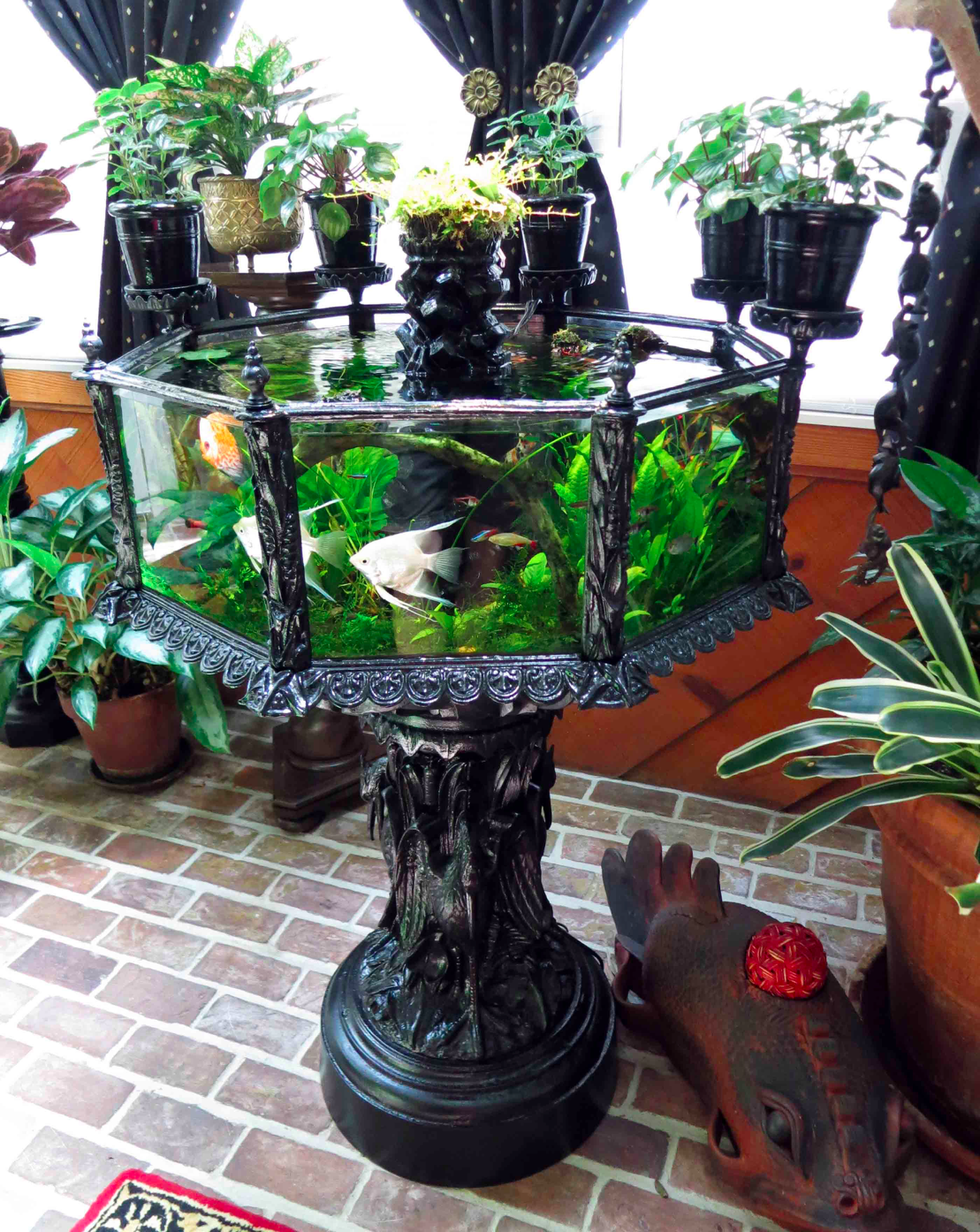
An example of a Victorian home aquarium, can be found here.
The craze surrounding home aquariums is still very much alive today, with fish outnumbering cats and dogs in homes as well as being reported as the second-most popular hobby in the United States. However, most aquarists fail to consider the impact that a displacement of organisms has on the marine environment. They are often collected by using toxins, which enables an easier capture but has detrimental impacts on local environments such as coral reefs. Additionally, only one of every ten fish that are captured for the aquarium trade, survive long enough to end up in a home aquarium. There is a sad irony within this, as aquarists are hurting the very environment that they are trying to replicate. The origins of home aquatics are linked to the sense of wonder associated with the unknown of the sea, with modern practices with the aquarium trade helping to destroy the spectacle that inspired the craze in the beginning.
WORD COUNT: 482
Bibliography
Austin Aquarium (2015) ‘History of Aquariums’, Austin Aquarium, 25th April [Online]. Available at: https://austinaquarium.com/history-of-aquariums/ (Accessed: 26th February 2019).
Brunner, B. (2012) The ocean at home: an illustrated history of the aquarium. London: Reaktion Books.
Brunner, B. (2015) ‘Through a glass, sadly’, Aeon, 30th November [Online]. Available at: https://aeon.co/essays/why-it-s-time-to-put-an-end-to-the-cult-of-the-aquarium (Accessed: 26th February 2019).
Brunner, B. (no date) ‘Bringing the ocean home’, The Public Domain Review [Online]. Available at: https://publicdomainreview.org/2018/06/21/bringing-the-ocean-home/ (Accessed: 26th February 2019).
Cain, S. (2014) ‘A book for the beach: Twenty Thousand Leagues Under the Sea by Jules Verne’, The Guardian, 24th July [Online]. Available at: https://www.theguardian-.com/books/booksblog/2014/jul/24/book-for-the-beach-twenty-thousand-leagues-under-the-sea-jules-verne (Accessed: 26th February 2019).
Copping, J. (2012) ‘One in ten Britons now have pet fish’, The Telegraph, 22nd April [Online]. Available at: https://www.telegraph.co.uk/lifestyle/pets/9217643/One-in-ten-Britons-now-have-pet-fish.html (Accessed: 26th February 2019).
Corbin, A. (1994) The lure of the sea: the discovery of the seaside in the western world, 1750-1840. California: University Press.
Gosse, P.H. (1856) The aquarium: An unveiling of the wonders of the deep sea. London: Van Voorst.
Hamera, J. (2012) Parlor Ponds: The Cultural Work of the American Home Aquarium, 1850-1970. Michigan: University Press.
Hickman, L. (2010) ‘What’s the impact of keeping fish?’, The Guardian, 19th March [Online]. Available at: https://www.theguardian.com/environment/blog/2010/mar/17/ask-leo-fish (Accessed: 26th February 2019).
Mason, A. (2017) ‘An ocean in the parlour’, Hakai Magazine, 24th March [Online]. Available at: https://www.hakaimagazine.com/features/ocean-parlor/ (Accessed: 26th February 2019).
PETA. (no date) ‘Fish in tanks? No thanks!’, PETA [Online]. Available at: https://www.peta.org/issues/animal-companion-issues/animal-companion-factsheets/fish-tanks-thanks/ (Accessed: 26th February 2019).
 An Odyssey of the Sea 1913572