“There I heard naught save the harsh sea”
Ezra Pound, The Seafarer.
The Seafarer is an Old English poem, that gives a personal account of the thoughts and feelings of a mariner. Although there are numerous translations of this poem in circulation, the specific example that is the focus of this blog post, is Ezra Pound’s translation from 1911, which can be found here. The job of a seafarer is infamously dangerous, even in the modern day it is the second most dangerous job in the world, in terms of number of fatalities. Additionally, the risk and danger associated with the job at the time of the poem’s inception, would have been much greater. The poem itself can be separated into 3 distinct sections, the first describes the narrator’s difficult relationship with the sea. The second section changes tone with a greater discussion around the adventure of a life at sea. Whereas, the third section moves away from sea-based imagery and focuses on a message derived from Christian principles.
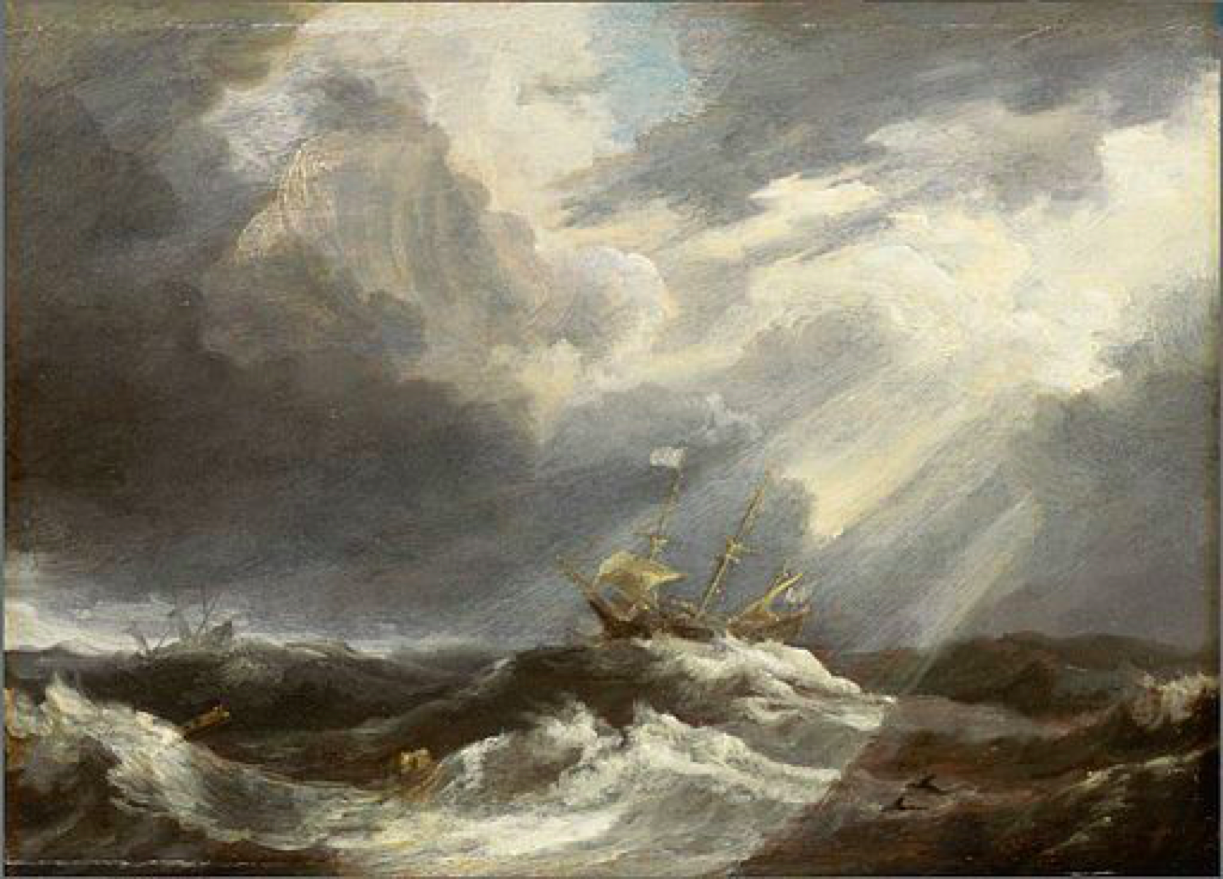
Example of a ship a seafarer would have worked on, by Bonaventura Peeters, can be found here.
Richard Marsden suggests that although the poem has a structure there is not a smooth passage that runs throughout the whole poem. This can be understood as reflecting the hectic nature of the life of a seafarer; who would often live as sea for months at a time, in poor quality conditions, with limited time in port. This would have significant psychological impacts on seafarers who would often suffer from loneliness going long periods of time without seeing their loved ones. This mirrors the structure of the poem, with the religious moral using imagery of the sea to take various unexpected twists and turns throughout. This connects with the idea of emulating how a seafarer knows their intended destination, where various unsuspecting impacts, like storms, may derail the journey for large periods of time.
Although the context within the Seafarer remains murky, it is important to consider the complicated relationship between the narrator and the sea. At the start of the poem, the seafarer laments the harsh conditions aboard a ship, citing the cold and the hunger. This brings together an awareness of the loneliness that the seafarer is feeling, by suggesting a desire for the comfortable life of the land-dwellers. However, once the poem moves into its second part, something has changed. It is theorised this could be a different of narrator or a change of season, but the seafarer has rediscovered their sense of adventure towards the sea. Thus, it becomes clear that the thrill and promise of exploration, helps construct the sea as an appealing lifestyle, despite the potential negative consequences. This provides an insight into the perception of the sea as a space of probable isolation. Despite this, there is a sense of wonder of the sea that encourages people to undertake the risks of a harder life that those who live on land, creating a belonging towards the sea and their colleagues that sail upon it.
WORD COUNT: 490
Bibliography
Calder, D.G. (1971) ‘Setting and mode in “The Seafarer” and “The Wanderer”, Neuphilologische Mitteilungen, 72(2), pp. 264-275.
Ei Ei Htwe, N. (2015) ‘The loneliness of the long-distance seaman’, Myanmar Times, 15th May [Online]. Available at: https://www.mmtimes.com/lifestyle/14490-the-loneliness-of-the-long-distance-seaman.html (Accessed: 25th February 2019).
Empric, J.H. (1972) ‘The Seafarer: An Experience in Displacement’, Notre Dame English Journal, 7(2), pp. 23-33.
George, R. (2011) ‘Sea no evil: the life of a modern sailor’, The Telegraph, 25th January [Online]. Available at: https://www.telegraph.co.uk/news/worldnews/8273847/Sea-no-evil-the-life-of-a-modern-sailor.html (Accessed: 25th February 2019).
Mandel, J. (1976) ‘The Seafarer’, Neuphilologische Mitteilungen, pp. 538-551.
Marsden, R. (2004) The Cambridge Old English Reader. Cambridge: University Press.
Meier, D. (2006) Seafarers, merchants and pirates in the Middle Ages. Suffolk: Boydell Press.
National Park Service. (no date) ‘What is it like at sea?’, National Park Service [Online]. Available at: https://www.nps.gov/safr/learn/education/upload/Sailor_intercept.pdf (Accessed: 25th February 2019).
O’Camb, B. (2017) ‘Seafarer, The’, in Echard, S. Rouse, R. Fay, J.A. Fulton, H. and Rector, G. (ed.) The Encyclopedia of Medieval Literature in Britain, 4 Volume Set (Vol. 1). London: John Wiley & Sons, pp. 1682-1683.
Orton, P. (1991) ‘The form and structure of The Seafarer’, Studia Neophilologica, 63(1), pp. 37-55.
Poetry Foundation (no date) ‘The Seafarer by Ezra Pound’, Poetry Foundation [Online]. Available at: https://www.poetryfoundation.org/poems/44917/the-seafarer (Accessed” 25th February 2019).
Queensland Government. (2017) ‘Day of the Seafarer – a time to reflect on life at sea’, Queensland Government, 23rd June [Online]. Available at: https://blog.tmr.qld.gov.au/blog/-2017/06/23/day-of-the-seafarer-a-time-to-reflect-on-life-at-sea/ (Accessed: 25th February 2019).
 An Odyssey of the Sea 1913572